
Birch for Interior Joinery and Architectural Trim
Interior joinery is where a panel's face is the product. Dongstar Wood's birch range runs from 2.7 mm to 30 mm in thickness across 1220 × 2440 mm, 1250 × 2500 mm and 1250 × 3000 mm sheets, in face grades from A down to a repaired-defect grade, and the light cream to pale brown birch veneer takes stain, lacquer and paint evenly enough that trim, shelving and panelling can be finished in place.
Key takeaways
- Thickness spans 2.7–30 mm across 1220 × 2440, 1250 × 2500 and 1250 × 3000 mm sheets, with custom sizes available.
- Four face grades are described: A-grade, B-grade, C-grade and a repaired-defect grade free of open defects.
- The compliance set spans E1, CARB P2 and CE documentation, each option paired with a low-emission glue system.
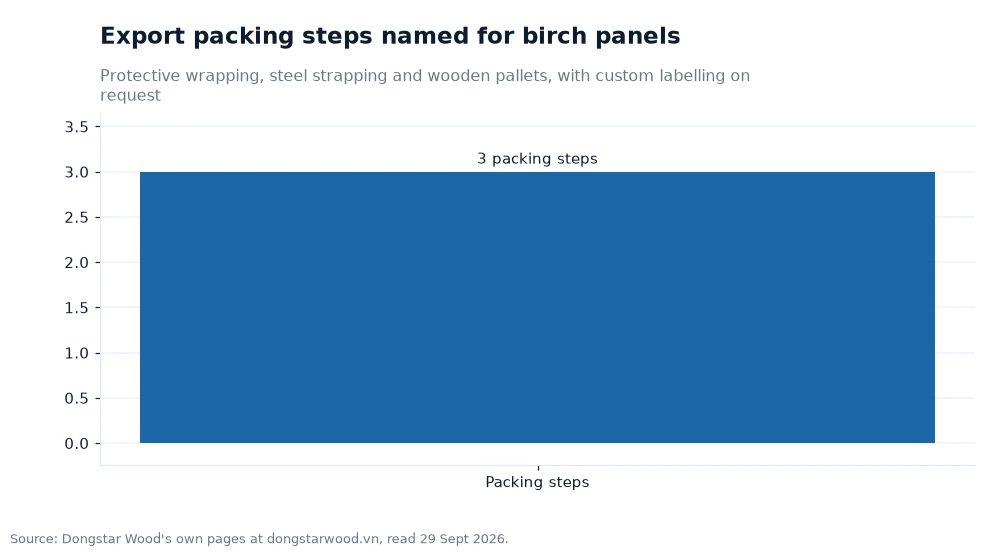
- Export packing is a three-step routine: wrap the pack, strap it, mount it on a wooden pallet — custom labelling on request.
Why birch suits visible joinery
Birch veneer is light cream to pale brown, uniform across the sheet, and calm enough that a clear finish reads as wood rather than as grain. That uniformity is what interior specifiers want: a run of shelving, a wall of panelling, a row of wardrobes all take the same stain, the same lacquer, the same paint without the colour matching that figured veneers demand. A Birch Plywood Supplier who publishes its grades plainly saves the joinery shop a round of emails. The client describes a multi-layer hardwood core that resists warping during machining, so the panel that leaves the factory flat stays flat through cutting, sanding and edge processing.
Face grades without surprises
The page describes four grades in plain language. A-grade is in outstanding condition with some knots and burls allowed. B-grade carries more and larger burls and knots, with some colour variation. C-grade is smooth and sound with even more variation in knots and burls. The repaired-defect grade is free of open defects but may carry some repaired defects. The practical reading for a joinery shop: the grade you choose is the grade you are prepared to fill, patch or paint around, and the repaired grade is the one to specify when the face must read clean under a clear finish.
Machining, moisture and European climates
The birch page is written for workshops: the panels are engineered to machine cleanly, with cutting, CNC work, sanding and edge processing all running with minimal tear-out, and the client claims moisture control and panel tolerance suited to European climates. For a buyer, those claims translate into two questions to ask before ordering — what thickness tolerance the mill works to, and how the panels are packed for a long transit. The answer to the second question is the export routine: the mill wraps each pack, straps it to a wooden pallet, and adds labelling, with custom packaging available for large projects.
Those two questions — thickness tolerance and packing — are the ones that separate a workshop order from a site order. Workshop panels need a tolerance tight enough that a CNC cutting list runs without manual adjustment, while site panels need a packing standard that prevents edge damage during a three-week transit to a port in northern Europe. The birch page addresses both, but only if the buyer asks: the tolerance is a conversation about what the press can hold, and the packing is a list of materials that ship with the panel. A workshop that knows its tolerance can cut a batch without test-fitting every sheet, which is the kind of efficiency that pays for itself across a programme.
Compliance options for interior work
Interior work in regulated markets runs on documents, and the birch page names them: E1 and CARB P2 compliance options, CE documentation, and low-emission glue systems. E1 is the emission class that keeps formaldehyde release low enough for occupied interiors; CARB P2 is the California Air Resources Board phase-2 standard that many North American buyers still reference; CE documentation covers the construction-product side. Asking for the compliance paperwork with the quotation — rather than after delivery — is the difference between a container that clears and one that waits.
Where birch panels end up
The application list reads like an interior contractor's week: furniture panels for cabinets, wardrobes, tables and chairs; interior joinery such as wall panelling, shelving and partitions; architectural elements including decorative panels, trim and mouldings; and commercial interiors in hotels, offices and retail. The same sheet does all of it because the face is the finish — a birch panel that machines cleanly and finishes evenly can be a cabinet door in the morning and a ceiling batten by Friday. Waterproof options using phenolic or melamine adhesives extend the same face into wetter rooms.
The surface treatment options widen the same face into more rooms. Birch veneer accepts a clear sealer that keeps the pale tone unchanged, a stain that moves the colour toward walnut or oak, a laminate that gives the surface a hard-wearing skin for a retail counter, or a paint that hides the grain entirely. The key point for a specifier is that all of these treatments start from the same face: the veneer is chosen first, the finish second, and the workshop that knows both can quote a programme without guessing at the material cost of the finish.
| Specification | Published option | Where it matters |
|---|---|---|
| Thickness | 2.7–30 mm | From lining panels to structural trim |
| Sizes | 1220 × 2440; 1250 × 2500; 1250 × 3000 mm | Standard sheets for joinery cutting lists |
| Face grades | A, B, C, repaired-defect | How much filling the finish allows |
| Compliance | E1, CARB P2, CE documentation | Occupied interiors and regulated markets |
| Packing | Wrapping, steel strapping, wooden pallets | Transit to European workshops |
Worked example: cutting a panelling run
Example only, using the published sizes. A wall run of 6.0 m fitted with 1250 × 2500 mm sheets laid lengthwise needs 6.0 ÷ 2.5 = 2.4 sheets per column, so three columns of sheets cover the run with the offcuts. Each sheet delivers 1.25 m × 2.5 m = 3.125 m², so three sheets cover 3 × 3.125 = 9.375 m² of panelling. At the published thickness range, a 6 mm lining panel and an 18 mm structural trim panel come from the same face grade, which keeps the finish consistent across the whole wall.
Frequently asked questions
What thickness does interior joinery need?
The birch range spans 2.7 mm to 30 mm. The right thickness follows the job — lining and drawer parts at the thin end, shelves, doors and structural trim at the thick end — and the mill publishes the full range on one page.
How do the face grades differ?
A-grade allows some knots and burls, B-grade allows more and larger ones with some colour variation, C-grade is smooth and sound with even more variation, and the repaired-defect grade is free of open defects but may carry repaired defects.
What compliance documents can be provided?
The page names E1 and CARB P2 compliance options, CE documentation and low-emission glue systems. Request the paperwork with the quotation so the container clears on arrival rather than waiting at the port.
From face grade to finished interior
The grade you specify is the finish you get, so decide how much filling the job allows before the order is pressed. A supplier who publishes grades, thicknesses and compliance options in one place makes that decision a two-minute read, and the commercial range shows the cores and glue classes that share the same factory. The company profile confirms the footprint behind the face. Joinery shops who fix the grade first tend to spend their sanding budget on the panels that need it.
Every number in this piece was drawn from the vendor's online documentation recorded on 29 September 2026[1].